The True Cost of Self-Publishing a Book in 2026
Nobody talks honestly about self-publishing costs. The internet is full of either “publish for free!” cheerleading or predatory services charging $20,000 for packages worth a fraction of that price.
The truth sits somewhere in the middle, and it depends entirely on your goals.
After working with dozens of manuscripts and watching hundreds of authors navigate this process, we’ve developed a realistic picture of what self-publishing actually costs. This isn’t about minimum viable spending. It’s about understanding where your money creates value and where it disappears.
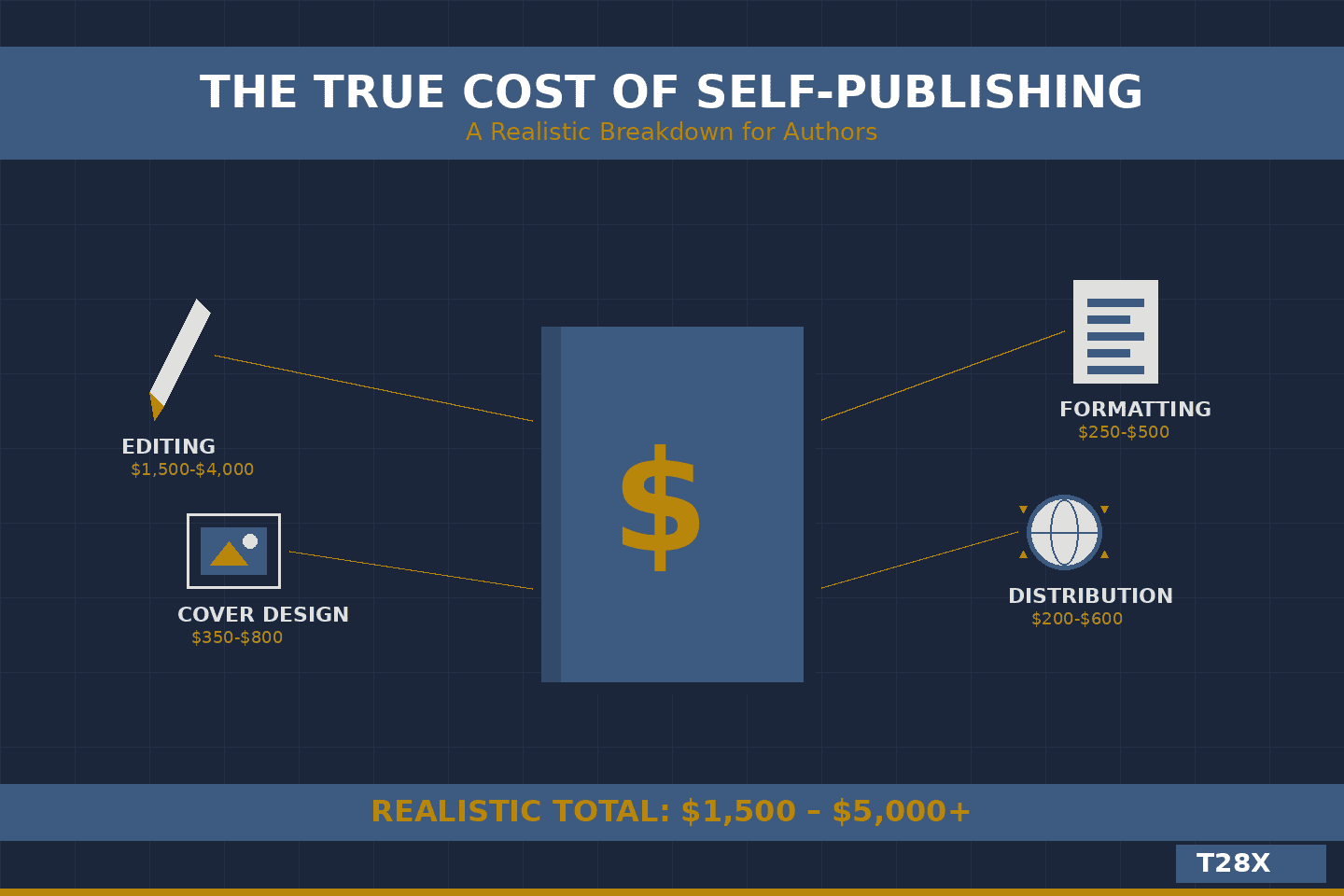
The four cost categories that matter are editing, cover design, formatting, and distribution. Everything else is optional until it isn’t.
Editing: The Non-Negotiable Expense
Editing is where most authors either overspend or dangerously underspend. Both mistakes are expensive in different ways.
Professional editing comes in several layers. Developmental editing addresses structure, pacing, character arcs, and whether your book actually works as a book. This runs $0.03 to $0.08 per word for qualified editors. A 70,000-word novel costs between $2,100 and $5,600 for developmental work.
Copyediting handles grammar, consistency, word choice, and sentence-level clarity. Expect $0.02 to $0.04 per word, putting that same novel at $1,400 to $2,800.
Proofreading catches typos, formatting errors, and anything copyediting missed. This lighter pass runs $0.01 to $0.02 per word, or $700 to $1,400 for our example novel.
Here’s what nobody tells you: most books don’t need all three passes. A clean manuscript from an experienced writer might skip developmental editing entirely. A book that’s been through multiple beta readers and critique partners might need lighter copyediting.
The danger is skipping editing altogether. Readers notice. Reviews mention it. Your book’s reputation suffers permanently for savings that amount to a few months of subscription services. We’ve seen authors spend $3,000 on marketing trying to overcome a $1,500 editing decision.
Budget realistically: $1,500 to $4,000 for most books, depending on length and starting condition.
Cover Design: Where Amateurs Get Caught
Your cover sells your book before your description does. This is not metaphorical. Eye-tracking studies show potential readers spend less than three seconds deciding whether to click on a thumbnail.
Professional cover design ranges from $200 for pre-made covers to $2,000 or more for custom illustrated work. The sweet spot for most indie authors sits between $300 and $600 for custom-designed covers using stock imagery.
Pre-made covers work if you find one that genuinely fits your book and genre. The risk is another author buying the same template, which happens more often than designers admit. For fiction especially, a cover that looks like twelve other books in your category defeats the purpose.
Custom illustration makes sense for specific genres—epic fantasy, middle grade, picture books—where illustrated covers are the norm. Elsewhere, photography-based or typography-focused designs perform equally well at lower cost.
The amateur mistake isn’t spending too little. It’s spending money on the wrong aesthetic. A beautiful cover that signals the wrong genre costs you readers who would have loved your book and attracts readers who will leave disappointed reviews. Research your category obsessively before briefing any designer.
Budget realistically: $350 to $800 for professional results in most genres.
Interior Formatting: Simple Math, Hidden Complexity
Formatting converts your manuscript into files ready for print and digital distribution. This sounds straightforward until you encounter the seventeen different specifications across publishing platforms.
DIY formatting using tools like Vellum ($250 one-time for Mac users) or Atticus ($147 one-time, cross-platform) makes sense if you’re publishing multiple books. The software pays for itself after two or three titles and gives you complete control over updates.
Professional formatting services run $100 to $400 for ebook-only, $150 to $500 for print-only, and $200 to $700 for both. Complex layouts with images, tables, or special typography cost more.
The hidden cost is revisions. Finding errors after formatting means paying again or learning to fix files yourself. This is why editing must happen before formatting, despite the temptation to see your book “looking real” as early as possible.
Print formatting involves additional decisions: trim size, margins, font choices, chapter headers. Each choice affects page count, which affects printing costs, which affects your pricing options. A formatter who understands these tradeoffs saves money downstream.
Budget realistically: $250 to $500 for professional formatting, or $150 to $250 in software for DIY.
Distribution: The Costs Nobody Mentions
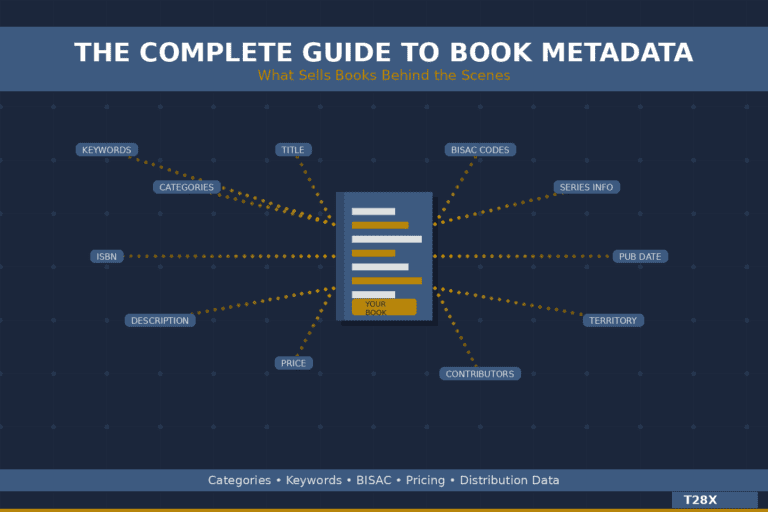
Distribution itself is technically free. Amazon KDP, IngramSpark, Draft2Digital, and other platforms don’t charge to list your book. The costs hide in the details.
ISBNs cost nothing if you use free identifiers from Amazon or Draft2Digital. But free ISBNs list Amazon or D2D as your publisher of record, limiting distribution flexibility and professional perception. Owning your ISBNs through Bowker costs $125 for one, $295 for ten, or $575 for one hundred. For serious publishers, the hundred-pack makes sense across a catalog.
IngramSpark charges $49 per title for setup, though they periodically offer free upload promotions. Annual revision fees apply if you update files. These costs add up across a backlist.
Proof copies run $3 to $10 per book depending on specifications, plus shipping. Budget for at least three proofs during production—you will find problems the screen didn’t show.
Then there’s the invisible cost: returns. IngramSpark distribution to bookstores and libraries requires accepting returns. When books come back, you’ve paid printing costs on inventory that generated no revenue. Most indie authors disable returns and accept limited brick-and-mortar distribution. This tradeoff deserves more discussion than it gets.
Budget realistically: $200 to $600 for ISBNs and platform fees, depending on scale.
The Hidden Category: Your Time
Every dollar you don’t spend translates to hours you do spend. Learning formatting software takes twenty hours. Researching cover designers takes ten. Managing editor communications, reviewing proofs, troubleshooting upload errors—the time cost of self-publishing rivals the financial cost for most authors.
Some authors enjoy the production process. If you find satisfaction in controlling every detail, the time investment delivers value beyond the book itself. If production feels like an obstacle between you and writing your next book, hiring help makes mathematical sense.
A freelance professional completes in two hours what takes a first-timer twelve hours. Unless your time has no value—and it does—this math matters.
Realistic Total Budgets
The minimum viable budget for a professional-quality self-published book sits around $1,500. This assumes careful spending: thorough but focused editing, a well-chosen pre-made or affordable custom cover, DIY formatting with proper software, and free distribution ISBNs.
The comfortable budget ranges from $2,500 to $4,500. This allows comprehensive editing, custom cover design, professional formatting, your own ISBNs, and enough proof copies to get everything right.
The premium budget exceeds $5,000 and adds developmental editing, custom illustration, audiobook production, or other enhancements that make sense for specific books and markets.
Spending under $1,000 typically means cutting something that will show. Spending over $7,000 typically means paying for services that don’t proportionally improve results.
What the Packages Don’t Tell You
Publishing service packages—the $3,000 to $15,000 bundles from various companies—often include services you don’t need at prices above market rates. A $5,000 package might include $2,000 worth of actual services plus $3,000 of “marketing support” that amounts to press releases nobody reads and social media posts nobody sees.
This doesn’t mean packages are always scams. Some authors prefer paying once for managed service rather than coordinating five freelancers. The convenience has value. Just understand what you’re paying for and compare itemized costs against hiring directly.
If a package won’t break down individual service costs, that’s information.
The Investment Mindset
Self-publishing costs money the way starting any business costs money. The question isn’t whether to spend but whether spending on this book, at this level, makes sense for your goals.
A book written primarily for family and friends justifies minimal investment. A book intended to launch a career or support a business justifies more. A book entering a competitive commercial category needs everything working—the market doesn’t grade on a curve.
The best returns come from authors who understand their book’s purpose, spend appropriately for that purpose, and protect their investment through quality execution. The worst returns come from either extreme: authors who refuse to invest in professional support, and authors who spend heavily without strategic thinking.
Your book deserves an honest assessment of both what it needs and what it’s worth. That assessment is the first step toward spending wisely.
Frequently Asked Questions
Should I pay for editing if I’m already a professional writer or English teacher?
Professional writing and editing are different skills. Technical writers, journalists, and English teachers often produce cleaner first drafts, but they still benefit from outside editing—particularly developmental feedback. The closer you are to your manuscript, the harder it becomes to see its structural problems. Budget for at least copyediting regardless of your background.
Can I barter services with other authors instead of paying cash?
Skill exchanges work in theory but frequently fail in practice. Unequal effort levels, different quality standards, and timeline conflicts create friction that damages both the work and the relationship. If you pursue barter arrangements, treat them as formally as paid work: written agreements, clear deadlines, defined revision limits.
How do I verify that an editor or designer is worth their rates?
Request samples of previous work in your genre. For editors, ask for a sample edit of your first chapter—most professionals offer this for free or nominal cost. For designers, review their portfolio for books that have sold well, not just attractive images. Check references from past clients. Be wary of providers who can’t demonstrate relevant experience.
Is it worth investing more in my first book to establish quality expectations?
Generally yes, with caveats. Your first book establishes your reputation and review base. Cutting corners creates problems that compound across your career. However, first books also involve learning curves that might be better spent on lower-stakes projects. Some authors intentionally publish a smaller work first to learn the process before their “real” debut.
Do audiobook costs follow similar patterns?
Audiobook production operates differently. Professional narration runs $200 to $400 per finished hour, making a typical novel cost $2,000 to $4,000 for production alone. Royalty-share arrangements through ACX reduce upfront costs but split earnings permanently. The audiobook market is growing but remains smaller than ebook and print. Most authors should establish their book in other formats before investing in audio.
How often should I update my published book, and what does that cost?
Minor corrections (typos, formatting errors) should happen immediately when discovered—platform fees are minimal for file updates. Significant revisions that might confuse existing readers need careful consideration. Updated editions make sense when information becomes outdated in nonfiction or when you’ve substantially improved as a writer and want backlist titles to reflect current abilities. Budget $100 to $300 per major update cycle for re-editing and reformatting.
What’s the biggest waste of money you see authors spend on?
Marketing services purchased before the book is ready. No amount of advertising fixes a weak cover, poor description, or unedited interior. We consistently see authors spend $500 to $2,000 on promotion for books that would have benefited far more from that money invested in production quality. Get the product right first. Marketing amplifies what’s already there—it doesn’t create quality that’s missing.