Book Metadata Guide: What Sells Books Behind the Scenes
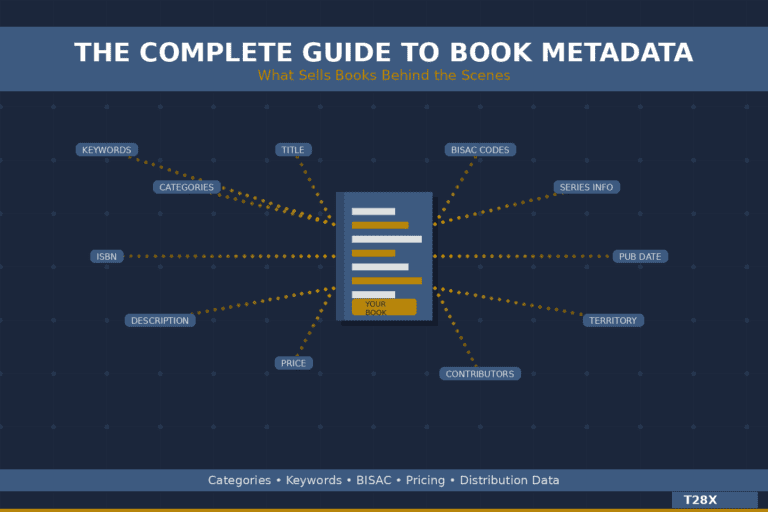
Every book carries invisible information that determines its fate in the marketplace. This data—metadata—tells retailers where to shelve your book, which searches should surface it, and what other books it resembles. Most authors ignore metadata until their book underperforms, then discover they’ve been fighting with one hand tied behind their back.
Metadata isn’t glamorous. It won’t appear in writing workshops or craft books. But understanding how the systems actually work separates authors who struggle with discoverability from authors who consistently reach readers.
What Metadata Actually Includes
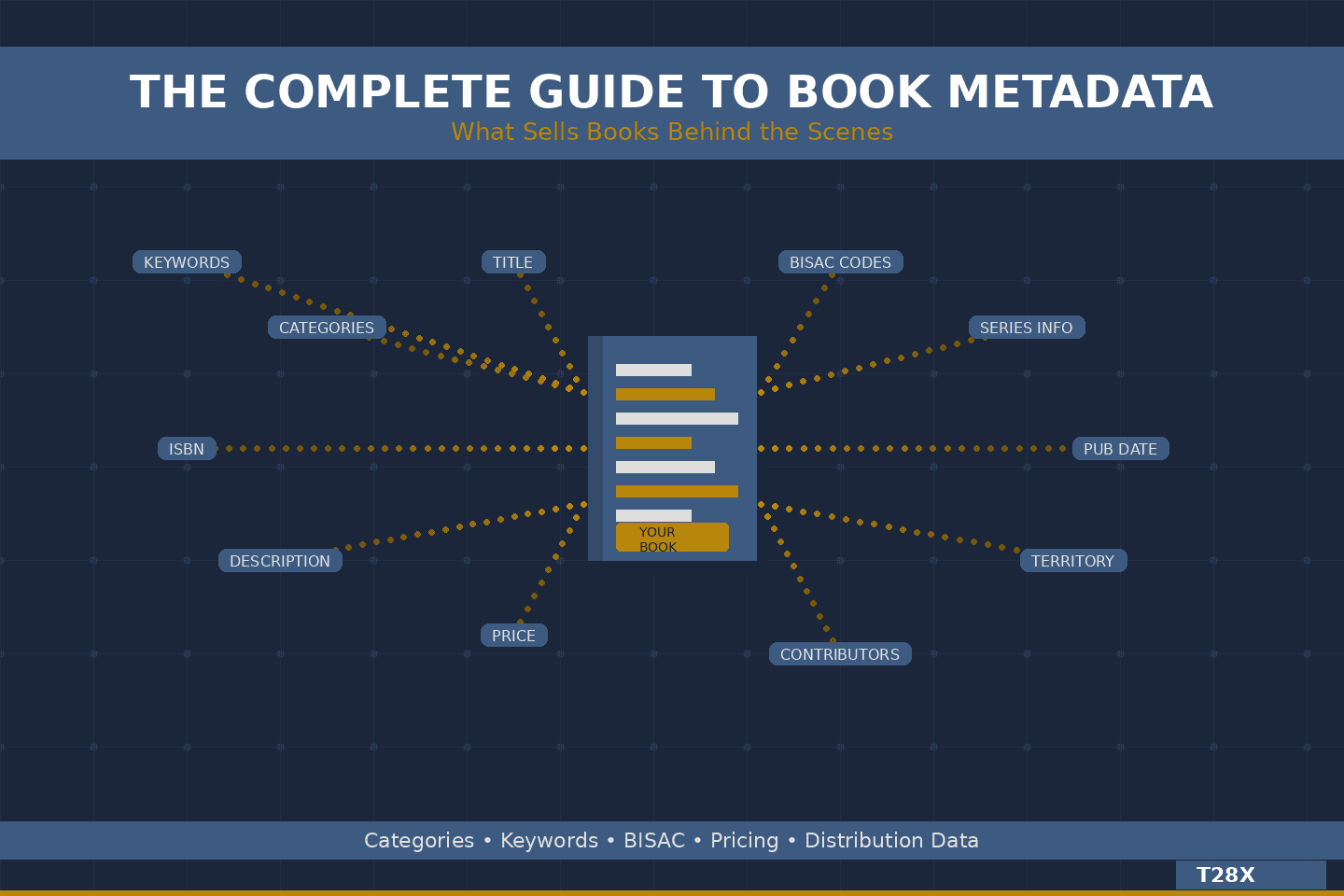
Book metadata encompasses everything about your book except the content itself. The complete picture includes title, subtitle, series information, author name, contributor information, publisher, publication date, format specifications, pricing, territory rights, descriptions, keywords, category codes, age ratings, and various identifiers like ISBN and ASIN.
Each data point serves specific functions in the retail and distribution ecosystem. Some affect search. Some affect recommendations. Some affect where your book physically or digitally appears. Some affect whether libraries or bookstores will consider stocking it.
The challenge is that different platforms use metadata differently, and optimizing for one system sometimes creates suboptimal results in another. Authors publishing through multiple channels navigate these tradeoffs constantly.
Categories and BISAC Codes
BISAC codes (Book Industry Standards and Communications) provide standardized category classifications used throughout the publishing industry. When you select categories on Amazon or describe your book to distributors, you’re working within or alongside this system.
The current BISAC structure contains over 4,000 subject headings organized hierarchically. Fiction breaks into genres, which break into subgenres. Nonfiction covers everything from philosophy to cooking to business, each with increasingly specific subcategories.
Amazon’s category system builds on BISAC but adds its own layer of complexity. Amazon categories are more numerous, more granular, and more frequently updated than BISAC. A single Amazon subcategory might map to one BISAC code, multiple BISAC codes, or no precise BISAC equivalent at all.
Choosing categories requires balancing several factors. Relevance ensures readers who browse your categories want books like yours. Competitiveness affects how easily you can rank within a category—a category with 50,000 books requires more sales to rank than one with 5,000. Visibility affects how many readers browse that category in the first place.
Most platforms allow two categories; some allow up to ten. Using all available slots increases discoverability but only if the categories genuinely fit. Miscategorized books generate disappointed readers, negative reviews, and algorithmic penalties that outweigh any temporary visibility gain.
The strategic approach starts with research. Identify books similar to yours that are selling well. Note their categories. Look for patterns across successful titles in your space. Find categories where your book would legitimately belong that have less competition than the obvious choices.
Keywords: The Hidden Search Layer
Keywords on Amazon and other platforms function as invisible tags connecting your book to reader searches. The right keywords surface your book for relevant queries. The wrong keywords either miss searches entirely or attract wrong-fit readers.
Amazon provides seven keyword slots with character limits (formerly 50 characters each, now effectively unlimited within reason). These keywords don’t appear on your book’s page—they only affect search behavior.
Effective keyword strategy requires understanding what readers actually search for. This isn’t always obvious. Authors think in terms of their book’s content and themes. Readers think in terms of what they want to experience or solve. The gap between author thinking and reader thinking is where optimization lives.
Keyword research tools like Publisher Rocket, KDP Rocket, or even Amazon’s own search autocomplete reveal actual search behavior. Typing the beginning of a phrase into Amazon’s search bar shows what readers commonly search for. These suggestions come directly from real user behavior.
Long-tail keywords—specific phrases rather than single words—often outperform generic terms. “Historical fiction ancient Rome” faces less competition than “historical fiction” while still capturing interested readers. The tradeoff is volume; fewer people search for long-tail phrases, but those who do are more likely to buy.
Avoid keyword stuffing—repeating keywords already in your title, subtitle, or description. Amazon already indexes those terms. Duplicating them wastes keyword slots. Instead, use keywords to capture synonyms, related terms, and alternative phrasings readers might use.
Update keywords over time. Search behavior changes. Cultural moments create temporary spikes in certain queries. Books that ranked for particular terms lose position as competition increases. Regular keyword audits—quarterly at minimum—keep your metadata performing.
Title and Subtitle Optimization
Your title and subtitle serve multiple masters. They must appeal to human readers, function within search algorithms, and accurately represent your book’s content. Optimizing for one at the expense of others creates problems.
Titles that include searchable terms perform better in discovery than purely creative titles. A thriller called “The Silent Hour” might be more evocative than “Murder in Manhattan,” but the second title captures searches the first misses entirely. This doesn’t mean abandoning creative titling—it means understanding the tradeoff.
Subtitles offer an opportunity to capture search terms the main title misses. Nonfiction especially benefits from keyword-rich subtitles. A book titled “Atomic Habits” adds “An Easy & Proven Way to Build Good Habits & Break Bad Ones” to capture searches for habit formation, behavior change, and self-improvement.
Series titles and volume numbering affect both human browsing and algorithmic sorting. Clear series designation helps readers understand reading order. Consistent naming conventions help Amazon and other platforms group series correctly for also-bought recommendations.
Avoid punctuation that confuses systems. Colons, em-dashes, and parentheses can break title parsing on certain platforms. Check how your title displays across all sales channels before finalizing.
Product Descriptions: Metadata Meets Marketing
Book descriptions occupy an unusual position—they’re both marketing copy designed to sell and metadata indexed for search. Effective descriptions serve both functions without compromising either.
Amazon indexes description text for search purposes, though keywords in descriptions carry less weight than keywords in dedicated fields. Still, a description mentioning “slow burn romance” will surface for readers searching that phrase when keyword slots alone might not.
Description structure affects conversion rate regardless of search function. The first 200 characters appear before readers click “Read more”—this preview determines whether they continue reading. Front-loading compelling hooks and key selling points matters more than chronological plot summary.
HTML formatting in descriptions improves readability on Amazon. Bold text, line breaks, and occasional italics create visual hierarchy that aids scanning. Wall-of-text descriptions lose readers before conveying value. Check formatting renders correctly across desktop, mobile, and app versions.
Avoid spoilers, exhaustive plot summaries, and author biography at the top. Readers browse descriptions to answer one question: is this book for me? Answer that question first. Everything else is secondary.
The Amazon A+ Content Layer
Authors enrolled in Amazon’s Brand Registry can access A+ Content (previously called Enhanced Brand Content)—additional formatted content appearing below the main description. This real estate significantly impacts conversion when used well.
A+ Content allows images, comparison charts, and formatted text layouts unavailable in standard descriptions. Most successful self-published authors use this space for visual appeal, series information, author branding, and additional book details.
The optimization principle remains: help readers decide your book is for them. Showcase interior samples. Highlight series connections. Provide context for nonfiction topics. Demonstrate production quality through professional images.
A+ Content indexing for search is limited. Treat it primarily as conversion optimization rather than discovery optimization. Get readers to the page through other metadata; use A+ Content to close the sale.
Price as Metadata
Price point affects more than revenue—it signals positioning and influences algorithmic behavior. Amazon’s categorization of deals, the visibility of price promotions, and reader perception of value all flow from this single data point.
Price must match reader expectations for your category. Romance readers expect ebook prices of $0.99 to $4.99 for most titles. Business book readers accept $9.99 to $14.99. Misalignment creates friction—pricing above expectation loses sales; pricing below expectation raises quality concerns.
Kindle Unlimited enrollment affects optimal pricing strategy. Books in KU earn page-read revenue that supplements or replaces direct sales. Authors maximizing KU performance sometimes price higher to discourage direct purchase in favor of borrows. Authors outside KU depend entirely on sales and price accordingly.
International pricing deserves attention. Amazon allows separate pricing for each marketplace. Currency conversion creates odd price points that can look unprofessional. Setting clean local prices (£3.99 instead of £3.87) demonstrates attention to detail.
Publication Date Strategy
Publication date metadata affects both discoverability and reader perception. New releases receive temporary algorithmic boost. Anniversary dates trigger potential promotional opportunities. Backlist dating affects perceived relevance.
Setting publication date in the future allows pre-order campaigns. Pre-orders accumulate and count toward first-day sales, improving launch visibility. The tradeoff is delayed actual publication—readers can’t access your book until the date arrives.
Changing publication dates on existing books requires caution. Some platforms interpret date changes as manipulation and may penalize accordingly. Legitimate reasons for date changes exist (new editions, significant updates), but changing dates purely for perceived freshness risks more than it gains.
Series publication timing affects readthrough. Launching books too close together doesn’t give readers time to finish one before the next arrives. Launching too far apart loses momentum and reader attention. The optimal cadence depends on genre and series structure, but 60 to 90 days between related titles is common for rapid release strategies.
Identifiers: ISBN, ASIN, and Beyond
ISBNs identify books universally across the supply chain. Each format—print, ebook, audiobook—requires its own ISBN. Using a single ISBN across formats violates industry standards and creates tracking problems.
Amazon’s ASIN (Amazon Standard Identification Number) serves similar functions within Amazon’s ecosystem. ASINs are automatically assigned; you cannot set or change them. When optimizing metadata, understand that ASINs determine how Amazon groups product pages, affects reviews, and handles edition relationships.
Linking editions properly matters for review aggregation and discoverability. Amazon should understand that your hardcover, paperback, and Kindle editions are the same book. When editions aren’t properly linked, reviews scatter and sales don’t compound into unified ranking improvement.
Publisher-provided ISBNs (from Bowker or international equivalents) versus retailer-provided free ISBNs affect metadata control. Free Amazon ISBNs list Amazon as publisher of record. Free D2D ISBNs list D2D. This affects library acquisition, professional perception, and long-term flexibility. Most serious publishers use their own ISBNs.
Metadata Maintenance Over Time
Metadata isn’t set-and-forget. Market conditions change, categories evolve, keyword performance shifts, and competitive landscapes transform. Regular metadata audits keep books discoverable as conditions change.
Quarterly reviews represent a reasonable maintenance schedule for most books. Check category performance—are you still ranking? Has competition intensified? Review keyword performance—are your keywords still relevant? Has search behavior changed?
Promotional periods deserve metadata attention. Before price promotions or advertising pushes, optimize metadata for maximum conversion. The worst outcome is paying for traffic that arrives at an unoptimized product page.
Significant book updates—new editions, additional content, cover refreshes—warrant comprehensive metadata review. Each change is an opportunity to reconsider positioning and optimize accordingly.
Track what works. Note metadata changes and correlate them with sales performance changes. Over time, you develop understanding of what moves the needle for your specific books and categories. This accumulated knowledge compounds across your publishing career.
Frequently Asked Questions
How do I find what categories competitors are using?
Third-party tools like Publisher Rocket reveal category data for any book. Alternatively, look at bestseller lists in various categories—if a book ranks in a category, it’s enrolled there. Amazon’s product pages also show some category information under product details, though not always completely.
Should I use different metadata for different retailers?
Yes, when possible. Each platform has different search algorithms and reader expectations. Keywords that perform on Amazon might not matter on Apple Books or Kobo. Category structures differ across platforms. Optimizing separately for each major retailer, rather than using one-size-fits-all metadata, typically improves results.
How quickly do metadata changes take effect?
Amazon typically reflects changes within 24 to 72 hours, though some changes take longer. Category changes may require approval and can take a week or more. Other retailers vary—some are faster, some slower. Plan metadata changes with buffer time before any event where you need the changes active.
Can I get penalized for changing metadata frequently?
There’s no official penalty for metadata changes, but suspicious patterns—like constantly cycling through categories to game bestseller lists—may trigger review. Legitimate optimization shouldn’t cause problems. Making changes weekly or even more frequently during testing phases is normal for serious publishers.
What’s the impact of getting metadata wrong initially?
Poor initial metadata means missing sales during the crucial launch window when algorithms are most willing to surface new books. Correcting later helps but doesn’t recapture lost launch momentum. Getting metadata right before publication is worth the effort.
How important is metadata for print versus ebook?
Ebook metadata has more direct discoverability impact because most ebook purchases involve search or browse behavior. Print metadata matters for Amazon print sales and especially for distribution through IngramSpark to bookstores and libraries, where BISAC codes directly determine physical shelving.
Should I hire someone to handle metadata optimization?
For authors publishing multiple books, learning metadata optimization yourself provides long-term value. For authors publishing occasionally or those who find the technical details overwhelming, metadata consultants exist and can be worth the cost. Expect to pay $100 to $300 for thorough metadata optimization of a single title.